


It’s a much harder question to answer than it seems. Because if you can get a sub, you should, right?
Most studio monitors don't go below 50Hz. Modern music has loads of content below that. Add a subwoofer, hear the full range, make better mixing decisions.
Grab a sub, problem solved, yes?
Not quite!
Low frequencies behave differently than mids and highs. They need space to develop, they interact weirdly with room boundaries, and they're notoriously difficult to monitor accurately.
A badly implemented subwoofer can make mixing harder. That’s before you factor in neighbors who don't appreciate 40Hz sine waves at midnight!
So let’s answer this question properly.
- The Problem With Monitoring Low End
- The Pro-Sub Argument
- The Counter Argument
- Understanding Room Requirements
- Is There a Workaround?
- Subs For Music Production: The Verdict
The Problem With Monitoring Low End
Most studio monitors start rolling off around 50Hz. KRK Rokit 5s roll off around 43Hz, while the PreSonus Eris E5s start dropping around 53Hz. Even the trusted Yamaha HS5s start to falter around 54Hz.
That means you're missing a full octave or more of the low end when you're mixing. Without a sub filling in that 20-50Hz range, you're basically mixing blind in the frequencies that separate bedroom demos from club-ready tracks. This is a huge culprit for why your studio mix doesn’t translate to other systems.
Now here's the complication. Low frequencies have incredibly long wavelengths. A 40Hz wave measures about 28 feet. A 30Hz wave is nearly 38 feet long. Most home studios aren't anywhere close to those dimensions.
When wavelengths are longer than room dimensions, the waves can't develop properly before bouncing off walls. They create standing waves where certain frequencies build up in some spots and cancel out in others.
The subwoofer might be outputting a perfectly flat response, but there are consequences and that too can screw up your mixing.
The best explainer on room acoustics
The Pro-Sub Argument
First, let’s look at the pro-sub argument and when the case for grabbing a sub is truly worthwhile or essential.
Bass-Heavy Genres Need It
Electronic music, hip-hop, trap, dubstep, drum & bass, the list goes on – these genres depend on sub-bass.
Without a sub, you’re speculating or using perception of the mid-lows. Often you’ll mistake the bass portion your speakers are producing for the sub bass portion and crank it up, only to realize you have no sub in your mix when you stick it on a bassy system, plus way too much mud in the mids.
This creates a frustrating trial-and-error loop that takes forever. With a properly calibrated studio subwoofer, you can make decisions in real time while working on your track.
Consumer Systems Have Bass Extension
Most playback systems now have extended low end. Car stereos, home theater setups, Bluetooth speakers, even modern earbuds.
When mixing on monitors that can't reproduce what these systems can, there's a mismatch between the monitoring environment and the listening environment.
So really, without a sub, you’re not just possibly falling short of mixing for bass-heavy systems, but also for standard consumer devices.
The Counter Argument
The counter-argument isn't that subwoofers are inherently bad. It's that they're easy to botch completely, and a poorly implemented sub causes more problems than it solves.
In many situations, a sub is going to give you some bass to listen to while messing up your mixes on the flip side of the coin – e.g. you might have too much bass clouding your perception.
Small Rooms Can't Handle It
When wavelengths are longer than room dimensions, monitoring accuracy takes the hit.
A 40Hz tone in a typical bedroom studio gets massively exaggerated in some spots and almost disappears in others. Move from the mixing position to grab coffee and the bass response completely changes.
This is super common – you mix at your desk, leave your track on, leave the room and think WTF is all that honking or mud.
Adding a subwoofer doesn't fix this – it amplifies it. More low-frequency energy bouncing around means stronger standing waves and worse problems.
Professional studios deal with this by building large control rooms with extensive bass trapping. The typical bedroom studio doesn't have the space or treatment, and pretending otherwise doesn't help.
Consumer Subs Versus Studio Subs
It’s common to use a home theater subs instead of one tuned for audio production – and this can be a fatal error.
Home theater subs are designed to make movie explosions sound impressive. They emphasize frequencies, add overtones, and color the sound in ways that feel good to consumers.
Studio subwoofers, however, aim for flat response and low distortion. So if you’re going to add a sub, find one that suits your system.
On this note, you’ll need to crossover frequency, phase alignment, level balancing, and room correction. It takes some thought to correctly integrate your sub with your system – though it helps if you stick to the same brands, e.g. a Rokkit sub for Rokkit monitors.
Understanding Room Requirements
If you want to add a decent-sized sub, you’ll need to consider your room acoustics:
- Ideally, dimensions of at least 12x12 feet, preferably 14x14 or larger
- Bass traps in corners and along wall-ceiling intersections
- Acoustic treatment throughout – absorption and diffusion
- Measurement tools to see what the room is doing to low frequencies
Without these basics, adding a sub means more problems. Let’s walk through a few steps to treating a bedroom studio-like space:
Bass Traps Are Your First Priority
Bass traps are thick, dense panels made from materials like rockwool or fiberglass that stop bass waves rather than merely deflecting them.
The most critical placement is in room corners – both floor-to-ceiling vertical corners and wall-ceiling horizontal corners. These are where bass energy naturally accumulates. Stack corner traps from floor to ceiling if possible. The more coverage, the better.
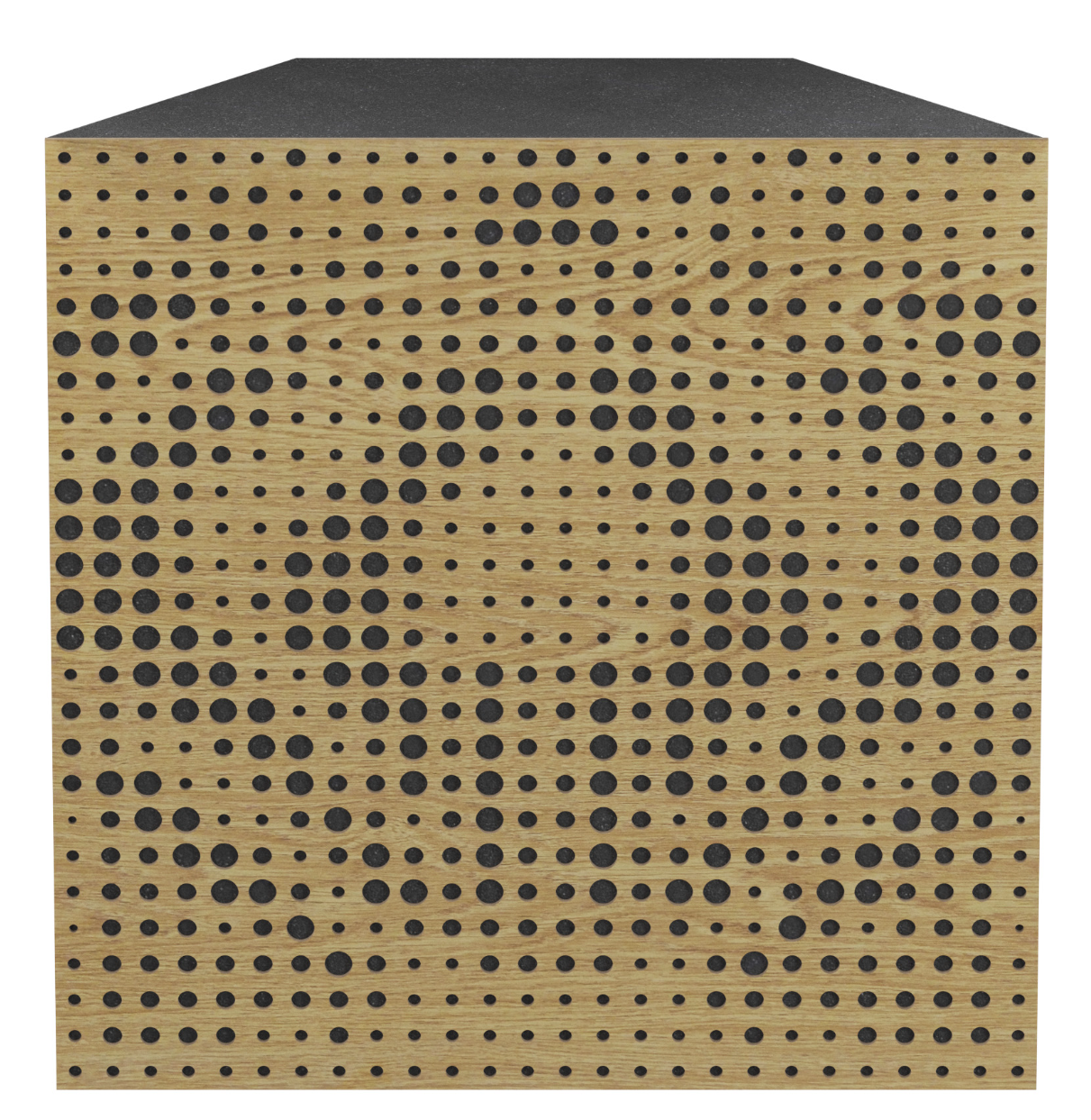
Wall-ceiling and wall-floor intersections come next. These are secondary problem areas where standing waves love to hang out. Even covering half of these edges makes a noticeable difference.
Behind your listening position is another key spot. Bass builds up at the rear wall and reflects back toward you, muddying what you're trying to hear. Large bass traps on the back wall help control this reflection.
Soft furnishings will help to some extent – particularly a bed or sofa placed in the middle of the room.
How Much Treatment Do You Need?
You're looking at a minimum of 4-6 corner bass traps, 2-4 panels for the rear wall, and ideally some treatment along wall-ceiling intersections. That's roughly 8-12 substantial pieces of acoustic treatment just for managing low end.
For a room around 12x14 feet, you might need 15-20% of wall surface covered with proper bass trapping to get decent control. Smaller rooms often need proportionally more treatment because the problems are worse.
DIY Versus Commercial Solutions
Commercial bass traps from companies like GIK Acoustics or Acoustic Fields can hit some $100-300 per panel. For a full room setup, you're easily looking at $1,500-3,000. That's real money, but it's also properly engineered absorption with known performance specs.
DIY rockwool panels can work if you're handy and careful. Roxul Safe'n'Sound or Owens Corning 703 are the go-to materials.
You're building wooden frames, wrapping rockwool in acoustically transparent fabric, and mounting them strategically. It’s cheaper but requires considerably more effort.
Now if you're just starting out and that's impractical, here are some legitimately helpful workarounds that cost next to nothing:
- Hang thick moving blankets or duvets in corner clusters where bass builds up. The thicker and denser, the better – multiple layers help.
- A full bookshelf with books at varying depths naturally breaks up reflections. Place them on walls opposite your monitors. The irregular surface scatters sound instead of reflecting it straight back.
- An old mattress leaned against the rear wall acts as decent mid-bass absorption.
- Hang dense fabrics, such as winter coats or hoodies, on clothing racks in problem areas. Sounds ridiculous, but it works okay for high-mids!
- Cover hard floors with rugs and carpets to reduce low-end reflections bouncing up. Thicker pile equals better absorption. Even a cheap area rug under your desk helps.
- Stack sofa cushions in corners or against walls for makeshift absorption.
- As mentioned, a bed or sofa placed in the middle of the room is ideal.
You can significantly improve a room's acoustics with these methods. In fact, actual bedrooms do actually lend some advantages for improving acoustics due to all the clothes, books, mattresses, etc.
You're much worse off in large empty rooms such as garages.
Measuring Effectiveness
Room EQ Wizard (REW) is free software that works with a calibrated measurement microphone like the MiniDSP UMIK-1 (around $75-100).
Run a frequency sweep – video below is a good tutorial – and REW shows you exactly where your room has massive peaks or deep nulls. It is quite confusing, but you only need to do it once to start with.
You can also critically listen to reference tones as you move about the room, trying to identify differences in symmetry or balance.
Is There a Workaround?
If a subwoofer isn't practical right now, you're not completely stuck. There are ways to mix low-end intelligently without hearing it directly.
Spectrum Analyzers Show What Your Ears Can't Hear
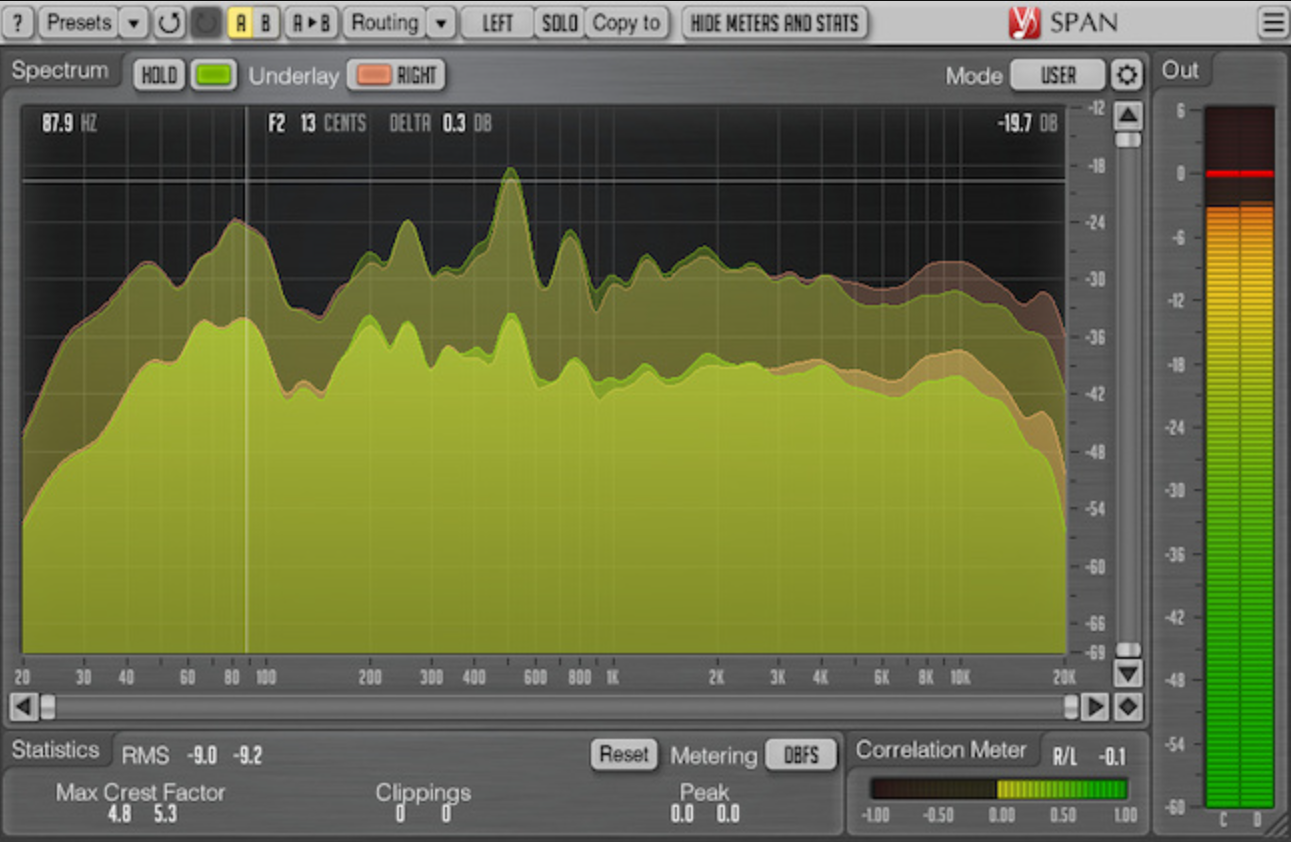
Tools like SPAN or the built-in analyzers in most DAWs display the frequency content below 50Hz.
You can load up a reference track – or better a few reference tracks – and compare the low-end activity to your own track.
Read our article on the ins and outs of using reference tracks.
Headphones Work for Checking, Not Mixing
Good closed-back or bass-extended headphones like Audio-Technica M50x or Beyerdynamic DT 770s can reveal sub-bass content your monitors miss.
But don't mix entirely on headphones – the stereo image and frequency response are too different from speakers. Use them as a cross-reference tool, not the primary source.
Test on Multiple Systems Religiously
Car stereos, Bluetooth speakers, laptop speakers, earbuds – each reveals different aspects of your mix.
The car test is legendary for a reason – though really frustrating when it doesn’t match expectations. Those systems have bass extension and show you immediately if you've gone overboard or left holes in the low end.
Subs For Music Production: The Verdict
If you’re mixing bass-heavy music, there’s no doubt that a good studio sub will improve monitoring accuracy and help you make better decisions.
But in a small, untreated room, a subwoofer often creates more problems than it solves. The money for a decent studio sub would first be better invested in room treatment. And if you’re not mixing bass-heavy music, better monitors is probably a better investment.
Small sub in an untreated room? Honestly don’t do it. Room treatment is so vital for proper bass response and behavior – it can’t be stressed strongly enough!
Looking to build outstanding bass regardless of monitoring setup? Sample Focus has thousands of bass samples, 808s, and sub hits for referencing against professional releases. Browse the collection and start building your track today!

Comments